Your gotra is your paternal lineage marker, and in Goswami and Dashnami families it is usually recorded as either a classical rishi gotra — Bharadwaj, Kashyap, Vashistha and others — or, in monastic lineages, through the name of the order and math your ancestors were attached to. The fastest way to find yours is to ask the eldest living man in your father's line, then confirm it with your family priest. Most families settle the question in a single afternoon.
This matters because "aapka gotra kya hai?" is one of the first three questions asked when a proposal comes up, and a wrong answer costs everyone weeks.
What a gotra actually is
A gotra traces descent through the father's line back to an ancient rishi. Two people sharing a gotra are treated as descendants of the same ancestor — in effect, distant siblings — which is why most Hindu families avoid same-gotra marriage even when no blood relation is traceable in living memory.
A few points that clear up most confusion:
- Gotra passes father to child. It does not change on its own.
- A bride traditionally takes her husband's gotra after marriage; her birth gotra is her father's.
- Gotra is not the same as caste, surname, sub-caste or kul devta. Families with the same surname often have different gotras.
- Pravara (the list of ancestral sages recited in rituals) sits alongside gotra and is what your priest will actually chant during the wedding.
We cover the reasoning behind the same-gotra rule in more depth in Goswami Gotra: Meaning and Why It Matters in Marriage.
Where Goswami and Dashnami names come from
The Goswami surname is closely tied to the Dashnami Sampradaya, the ten monastic orders organised in the tradition of Adi Shankaracharya. The ten order-names are:
- Giri
- Puri
- Bharati
- Ban (Van)
- Aranya
- Parvat
- Sagar
- Tirth
- Ashram
- Saraswati
Many families still carry one of these as a second surname — Goswami Giri, Goswami Puri, Goswami Bharati — or use it alone. Over generations, householder branches settled across Rajasthan, Gujarat, Uttar Pradesh, Bengal, Assam, Maharashtra and the South, and local record-keeping habits diverged. That divergence is why two Goswami families can describe their lineage in two completely different vocabularies and both be right.
Gotras commonly recorded by Goswami and Dashnami families
There is no single official register, and any list circulating online should be treated as a starting point rather than proof. That said, these are the rishi gotras Goswami and Dashnami householder families most often record:
- Bharadwaj
- Kashyap
- Vashistha
- Gautam
- Atri
- Shandilya
- Vishwamitra
- Kaundinya
- Parashar
- Kaushik
- Bhrigu
- Angira
- Garg
- Vatsa
- Agastya
- Mudgal
- Upamanyu
- Jamadagni
In strictly monastic Dashnami lineages the picture is different. Initiated sanyasis renounce the household lineage, and the guru's order becomes the line of descent. Families descended from such lineages sometimes record Achyuta or Bhurbhuva as the gotra, and sometimes record no rishi gotra at all — naming the math and the order instead. Neither is an error, and neither should be treated as a defect during a rishta discussion.
If your family has always given the order name — Giri, Puri, Bharati — when asked for gotra, say exactly that. Do not adopt a rishi gotra you cannot substantiate simply to make the answer sound more conventional.
Four ways to trace your own gotra
Work through these in order. Stop at the first one that gives you a clear, consistent answer.
- Ask the eldest man in your father's line. Your grandfather, father, or your father's eldest brother. This resolves the question for most families immediately.
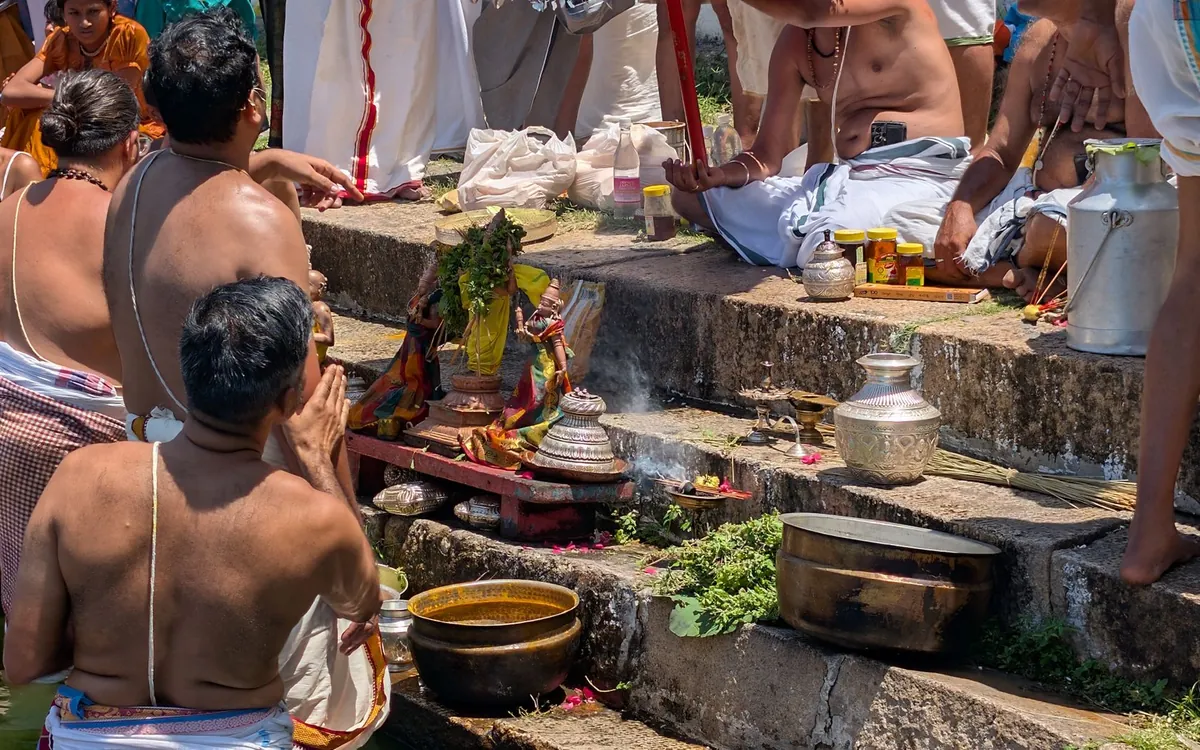
- Ask your family priest. The purohit who conducts your household ceremonies recites the gotra and pravara at every sankalp. He has heard it dozens of times and often has it written down.
- Check your family papers. Look at old wedding invitation cards, kundlis prepared at birth, shraadh or pind daan records, temple donation receipts, and any vanshavali your family keeps. Gotra is usually printed on the horoscope itself.
- Visit your ancestral pandas. Hereditary genealogy keepers at Haridwar, Varanasi, Trimbakeshwar, Gaya and Nashik maintain family registers going back many generations. Carry your village name, district, and the names of two or three ancestors, and they can usually locate your bahi.
Write the answer down once you have it, along with who confirmed it. Ten years from now, someone in your family will need it again.
How gotra is used when a rishta comes
In practice, gotra is a filter applied very early — usually before horoscopes are exchanged, sometimes before photographs are.
The common rules families apply:
- Same gotra as the boy's: most families decline. This is the near-universal rule.
- Same as the mother's gotra: many families also avoid this (matra gotra), though the practice varies by region and is applied less strictly.
- Same as the paternal grandmother's gotra: avoided in some traditions, ignored in others.
Because of this, listing your gotra accurately on your profile saves real time. Families searching brides and grooms on Goswami Matrimony frequently rule matches in or out on this field alone, and an incorrect entry means the conversation ends after two calls instead of before the first. If you have not set up your profile yet, you can register here and add the field while the details are fresh.

If the gotra is unknown or the two match
Neither situation ends a match on its own.
If nobody in your family knows it, this is far more common than people admit — particularly for families who migrated, converted from a monastic lineage, or lost records during partition or relocation. Speak to your family priest. Many purohits will assign Kashyap gotra, which is traditionally accepted where the lineage cannot be established. State this openly to the other family rather than leaving the field blank.
If the two gotras match, ask your priest before assuming the match is dead. Some families accept a match when the pravaras differ, when the two lines come from distinctly separate regions with no shared ancestry in memory, or when the surname is shared but the lineage demonstrably is not. Others will not, and that decision deserves respect rather than argument.
One thing worth keeping in perspective: gotra tells you who your ancestors were, not whether two people will be happy together. It is a legitimate first filter, but temperament, values, health, expectations and family fit decide the marriage. For the fuller picture, see our checklist for choosing a life partner.
Frequently asked questions
Can two people with the same gotra marry legally in India?
Yes. The Hindu Marriage Act does not prohibit same-gotra marriage, and no Indian law bars it. The restriction is a social and religious custom, not a legal one, so the decision rests entirely with the two families.
Do all Goswami families have the same gotra?
No. Goswami is a surname used by families across many regions and lineages, and gotras vary widely between them. Two unrelated Goswami families can easily have different gotras, and sharing the surname does not imply sharing the gotra.
Does a woman's gotra change after marriage?
By tradition, yes. A bride is considered to enter her husband's gotra after the marriage rites, which is why the groom's gotra is used for her in later family ceremonies. Her birth gotra remains her father's and is what is used when her own match is being considered.
What if my family follows a Dashnami order instead of a rishi gotra?
That is a valid and recognised lineage record. State the order name — Giri, Puri, Bharati, Saraswati or another — exactly as your family has always given it. Your family priest can explain how it is used during the wedding sankalp.
Is gotra the same thing as kul devta or kuldevi?
No. Gotra is a paternal lineage marker traced to a rishi, while kul devta or kuldevi is the family deity a household worships. A family knows both, and they are recorded and used for different purposes.